शुक्रबार , अषोज २३, २०८३

There was a time when Bhumiraman didn't have a fixed address for eating, sleeping, or resting. A man who now has a permanent home could, in just an hour's time, be found in some community forest near Dhola.
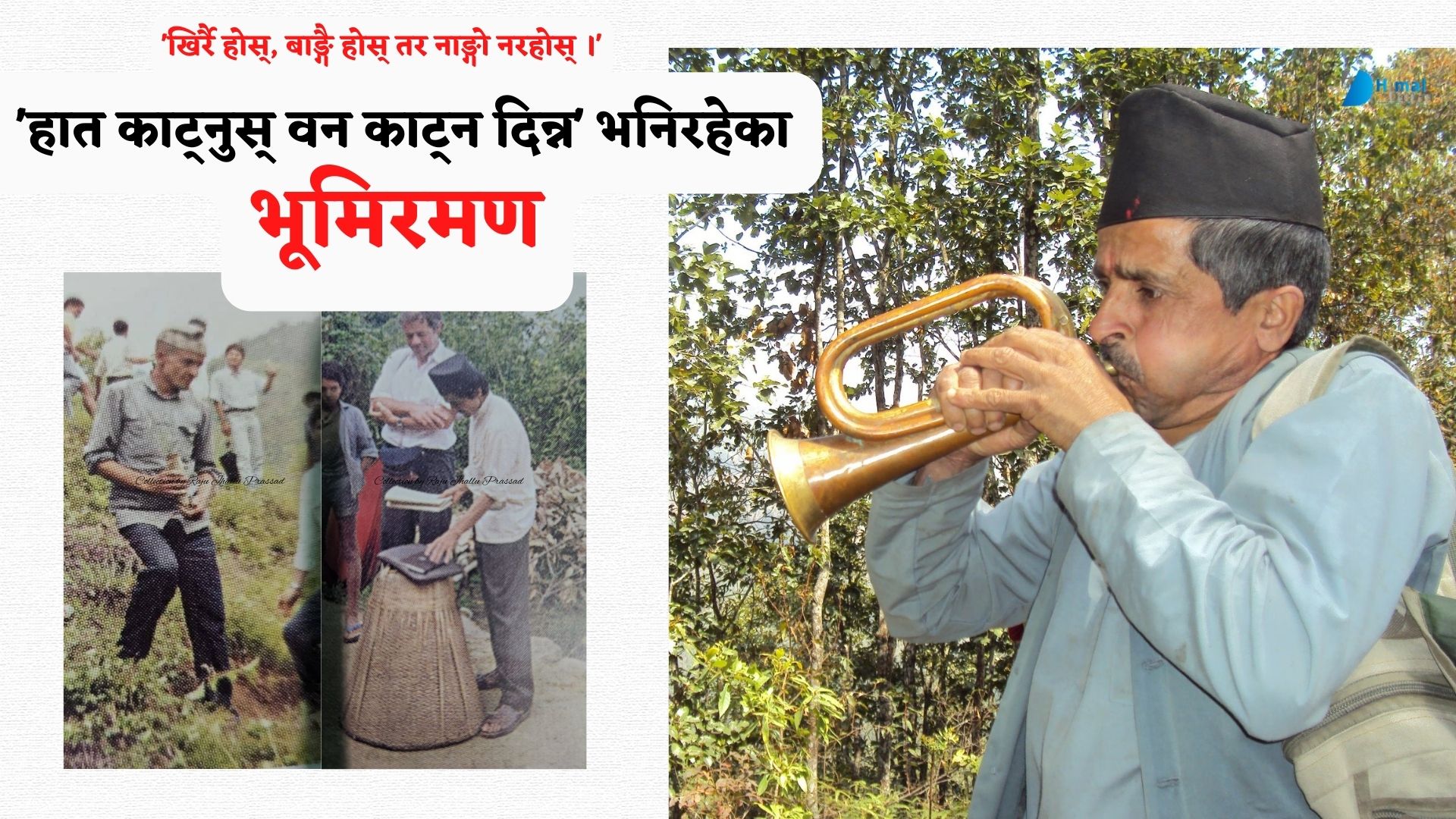
One morning, you’d find him in the Gumdi Chelang Community Forest, and by the afternoon, he’d have made his way to Salang Thulo Ban to hear about the happenings there.
He carried with him thousands of complaints from community forest users and a heavy load of grievances from the technical staff at the District Forest Office. He was intimately familiar with the horrors of forests being felled by smugglers in the dead of night and the dangers of being posted there without any security.
But who was he? Who was this person who understood everyone’s misfortune and felt compelled to listen to all their problems? He himself didn’t seem to know. Why did he cry, sobbing as if his own feet had been severed, when someone cut down a healthy tree? Why did he risk his life with such fervor to put out forest fires? He didn’t have the answers. Who was he, really? And where did he draw this inspiration from? Every question remained unanswered. Whoever he was and whatever he was, he is Bhumiraman Nepal himself. He is the ordinary farmer of Basaha, who has become synonymous with forest and environmental conservation. This isn’t driven by taxes, power, or deceit; it’s the product of his own inner motivation.
Every person has some interest, attachment, routine, and lifestyle. People live by their interests. They serve through their desires. They succeed or fail based on their attachments, and within their daily routines, they spend the entirety of their lives. It is because of these attachments, interests, practices, or working styles that we pin labels on people or hand them titles—’leader,’ ‘poet,’ ‘activist,’ ‘social worker,’ and so on.
A person cannot become established solely based on one type of interest or desire. It is because of our different temperaments and interests that our perspective becomes broad, and we all see things differently. Born in Sankhu, Nilkantha Municipality, if Bhumiraman Nepal has earned any recognition, it is fitting to call him a visionary. He has trekked through and explored the lands of about 65 districts in Nepal, all in the name of community forest conservation and entirely at his own expense.
He was born in Sankhu, Nilkantha Municipality, on Shrawan 6, 2013 BS (around July 1956). His maternal uncle was a government employee with considerable influence in the courts, which helped young Bhumiraman land a job, albeit a low-ranking one. His duty was to travel to remote highlands (lek) as a court bailiff, serving legal summons. In these areas, he would see massive Himalayan silver fir and Chir pine trees felled, their timber cut into planks for roofing houses. The sight of these felled trees wrenched his heart. While serving summons in various villages, he collected countless memories of women expressing a desperate unwillingness to offer him lodging because they had no drinking water. He saw many examples of children forced to quit school because they had to wait all day for their turn at dried-up water spouts and shallow wells. It was this that drew him into the environmental protection movement, particularly the massive campaign for tree planting.
‘Crooked or Bent, But Let It Not Be Bare’
There’s a saying in Nepali: “A fist can give its life, but it can’t satisfy anyone.” These days, Bhumiraman Nepal, the community forest activist, must be experiencing exactly that. There was a time when he had a job at the court—a small but regular income. He would buy enamel paints, brushes, diaries, and minute books and run across the hills, writing slogans on stones:
‘Crooked or bent, but let it not be bare.’
‘Let’s look at these bare hills and slopes and ask ourselves, where is the forest for the future?’
He would write these slogans alone, in solitude. The community would become curious. Who wrote this? Isn’t this exactly what we need to hear? He would visit areas where water sources had dried up and springs were scarce, and tell the people, “The water has dried up because of our own doing. When there was forest up there before, there must have been plenty of water here, wasn’t there?”
He would meet those willing to listen one-on-one and explain things to them. Through those individuals, he would gather the community. He wasn’t much of a public speaker, but he would explain things as if he were talking to each person individually, one by one. The chain of his selfless work grew immensely.
Bhumiraman’s job was a court bailiff. Despite his low-ranking job and not-so-great family circumstances, he dedicated himself to conservation. He was committed wholeheartedly. His salary from the court would be spent just on his travels. It would be exhausted on forming community forest user committees, calling meetings, and providing refreshments at those gatherings. To attend these meetings, he would sneak away from home, claiming a family member was ill, while at the office, he’d say he had court work. It felt like the sole purpose of his life was environmental conservation.
His office was a place teeming with litigants and complainants. He would counsel both parties who came to file suits, advising them to focus on forest conservation instead. In some cases, he actually managed to reconcile warring parties, sending them off carrying saplings to plant. He even appointed them to the working committees of community forest user groups. Because he was such a gentle, honest, and hardworking employee, he was given the nickname ‘Number One Door.’
Taking advantage of his gentleness and simplicity, after 2036 BS (around 1979), some senior officials made him sign blank paper, accusing him of “taking money from a forest project, what salary do you need?” and pocketing his pay themselves. Bhumiraman, however, was so engrossed in his conservation work that he let them do it, thinking, ‘Let them eat the money, as long as they don’t interfere with my work.’
After his salary was taken by others, Bhumiraman’s life became increasingly difficult. He was left with almost nothing. At that time, he had to rely on donations from people like Bhaktabahadur Gurung of Dhumakot, Tekbahadur Samari of Basaha, and Rilbahadur Gurung of Khalte-7 just to get by. Without those kind individuals, he would have been forced to sell his land and house back then.
By 2045 BS (around 1988), Bhumiraman’s public reach had become widespread. He had already established nearly a hundred community forest conservation groups, ranging from Lapa Khading in far northern Dhading to Jiwanpur in the south, and from Ri Tawal to Jogimara. The forests organized under his guidance back then—like Ahale Chirringe Ban, Bhusunde Pakha Ban, and Dunde Pakha Ban—are now considered model forest areas of Nepal.
His voluntary and selfless efforts in community forestry attracted so many people to him at the court that the sight of the crowds coming to see him was a spectacle. Some officials, seeing this public interest and respect, became suspicious. They accused him of being an underground political worker and prepared to take action against him. Not only was his salary suspended, but he was also transferred to Nuwakot as punishment. At that time, there was no one to speak out against the fate of being unfairly punished for serving the country and society.
Even after his transfer to the Nuwakot court, he found ways to pursue both his job and his forest conservation work simultaneously. There too, he launched a campaign to form community forests by bringing together the bare hills and their neighboring villages. He intensified his activities, organizing and protecting dozens of groups in areas like Taruka, Budhasingh, Dangsing, Dhikuri, and Madanpur. While in Nuwakot, he was again transferred as punishment, this time on the charge of being associated with the then-banned Nepali Congress party.
Bhumiraman didn’t just start the campaign to nurture forests; he also began advocating that the forests nurtured by villagers should be managed and given rights over by the local users themselves. His advocacy for the forests and their users even led to threats of being reported to the police. His demand was that forests should be under the people’s control—the people are the ones who protect them, and they should be the ones to plan and benefit from their use. Everyone who heard his campaign and his demands grew suspicious. Some even accused him of being a member of some underground political party.
In 2043 BS (around 1986), he unexpectedly received the ‘Jarajuri Puraskar’ (an award for his contributions). The news of the award was broadcast across the country prominently by Radio Nepal. Only then did he begin to receive high-level recognition and respect. People started to consider Bhumiraman as a ‘national treasure’ in himself. Consequently, arguments grew stronger that he should be transferred to the District Forest Office.
While the efforts of him and activists like him had brought a grassroots awakening and a war-level effort to community forest conservation in the country, the legal regulations hadn’t caught up. The movement that started in 2038 BS (around 1981) hadn’t taken a concrete shape even by 2051 BS (around 1994). He even led processions of fellow users to besiege the Singha Durbar (the central government secretariat) in Kathmandu.
The Affidavit: ‘Willing to Have My Own Hands Cut Off’
On Poush 27, 2049 BS (around January 1993), Bhumiraman Nepal had signed an affidavit agreeing to the punishment of having his hands cut off. He had declared, “I am willing to have both my hands cut off, and for that, I will not lodge a complaint anywhere.” In the village of Lankuri, Dailekh, the water sources had dried up after alcohol distilleries (bhatti) had consumed the forest. Fodder for livestock had become a thing of the past. People had to travel a day’s walk just to collect firewood. So, the villagers themselves had become aware and united to protect their forest, loving it like their own children. They also had a tradition of guarding the forest by taking turns. Bhumiraman had heard about the Lankuri forest in Dailekh through environmental newsletters and other media.
Driven by the curiosity to see what these people, who like him had dedicated their lives to the forest movement, were doing differently, Bhumiraman reached Lankuri. He was captivated by the enchanting beauty of the forest, spent the day wandering and taking photos, completely forgetting his hunger and thirst amidst nature’s embrace. Having spent the day lost in the forest, he couldn’t stay there at night, so he entered the village looking for a place to stay.
As soon as he entered the village, people started gathering around him, one by one. A barrage of questions hit him: Where did you come from? Why did you come? Who sent you? Why did you take pictures of our forest? He was overwhelmed. They were not ready to believe that he had simply come from Dhading to Dailekh just to see the forests. They suspected he was a spy from somewhere. Even as midnight approached, he kept explaining and trying to clear his name, but no one would believe him. They reached a conclusion that he must be punished. The night deepened, and the crowd grew, with more people insulting and threatening him.
After midnight, one of the locals pronounced the verdict: for entering our forest without permission and taking photos, both his hands must be cut off. In the end, it was decided he would lose both hands. The agreement was that he would be let go, but both hands would be cut off for visiting and photographing their forest without permission. “Cut them so they don’t hurt too much,” he said nonchalantly. Someone grabbed his bag, dug through it, and looked inside. Inside was a copy of the *Environment Newsletter* which had his photo printed, along with a piece on him. Someone pulled out the newsletter and started reading it.
“I think I read this somewhere,” one person said.
“I’ve heard the name Bhumiraman before too,” another added.
One by one, the crowd of villagers thinned out. Filled with shame, people apologized and turned back. Feeling relieved that he was lucky to be alive, he felt a surge of emotion. Tears suddenly flowed from his eyes, and he sat down on the veranda with a thud.
The Trishuli Incident
After the advent of multi-party democracy, many forests along the highways were destroyed. Even the saplings of the Khair tree were disappearing. To see firsthand how the forests were being depleted, he was spending nights alone in the highway areas. At midnight, carrying his camera in a bag, he wrapped himself in a coarse blanket and lay down near a watermill (ghatt) like a madman. Around 1 a.m., the road suddenly fell silent, and about a hundred people began carrying timber. A large truck arrived and stopped. They began loading the wood quickly. Bhumiraman emerged from under his blanket. Some shouted, “Who’s that? Throw him in the Trishuli!” While others said, “No, he’s just a madman, why kill him? Let him go.” He didn’t dare take a photo. He went back to sleep by the watermill. After this, he informed the District Forest Office, the Department of Forests, and the environmental journalist groups about this incident, which did help to curb the smuggling somewhat. This incident took place on Falgun 29, 2049 BS (around March 1993).
Like a high-speed car, Bhumiraman’s momentum in the conservation movement, which had surged after 2036 BS (around 1979), didn’t stop even after the start of the Maoist insurgency in 2051 BS (around 1996). Some might have called him a Maoist, others a government spy, but his footsteps never faltered. Because of his campaign, the hills and slopes of the villages are lush and green today. The saplings planted back then have now grown into giant trees.
The only thing that has changed is his age. He is now well into his sixties. He has turned his own land, where rice and corn used to grow, into a nursery. He distributes saplings to people in the villages. He still urges people to plant trees to conserve any remaining bare slopes. While his passion, energy, and enthusiasm haven’t died, something has definitely changed: society’s interest.
These days, society doesn’t want to do any work without money. In a world where people say, “The government should give us money to build our own houses,” where is the interest in social work? He expresses some disappointment. Even though his attachment to the conservation campaign hasn’t lessened, his age and family circumstances have prevented him from venturing out as much. The house he had managed to buy in the district headquarters was sold off in the course of his conservation work. He offered up all his savings as a sacrifice for the forest. His children’s education suffered, but he feels no regret. “I did what the era needed,” he says.
Even though society is gradually forgetting him, Bhumiraman continues to light a lamp in the darkness around him with his selfless deeds. He continues to spread light. Come, let us also add oil to that lamp.





हिमाल दर्पणले ‘नहतारिऔँ, ब्रेकिङ समाचारको पछि नदगुरऔँ’ भन्ने उद्देश्यले काम सुरु गरेको छ । पर्यटन, इतिहास, संस्कृति, मिडियालक्षित बहस, किनाराकृत विषयवस्तु एवं कला-साहित्यसँग नजिक भएर समाचार सामग्री (शब्द, दृश्य र अडियो) प्रकाशन गर्नु हाम्रो मुख्य ध्येय रहेनछ ।
हिमाल दर्पणले ‘नहतारिऔँ, ब्रेकिङ समाचारको पछि नदगुरऔँ’ भन्ने उद्देश्यले काम सुरु गरेको छ । पर्यटन, इतिहास, संस्कृति, मिडियालक्षित बहस, किनाराकृत विषयवस्तु एवं कला-साहित्यसँग नजिक भएर समाचार सामग्री (शब्द, दृश्य र अडियो) प्रकाशन गर्नु हाम्रो मुख्य ध्येय रहेनछ ।
DEPARTMENT OF INFORMATION AND BROADCASTING Regd Number : 2531/077-078
Editor: Raja Ram Paudel
Swayambhu - 15
Kathmandu, Nepal
© Copyright 2026, HimalDarpan. All Right Reserved. | Website by Nirvan Studio